

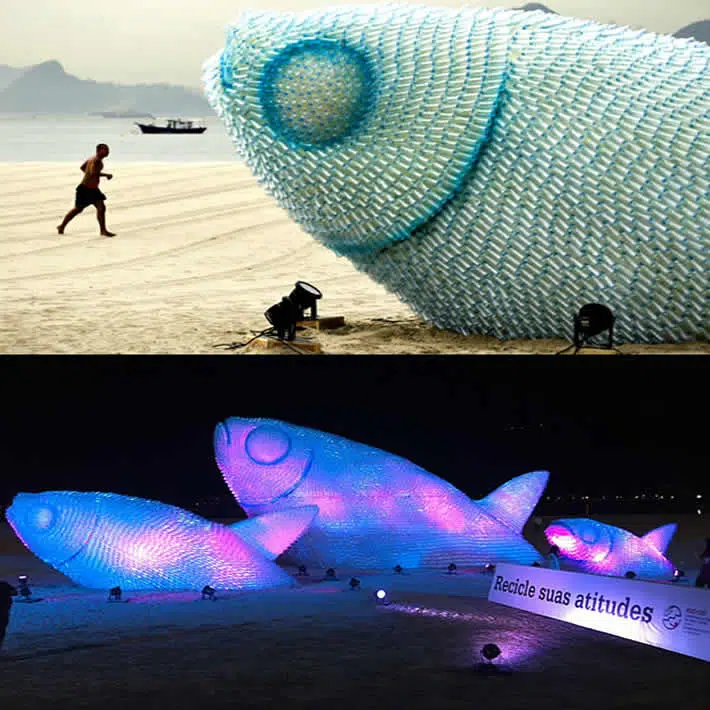
When you explore upcycled design projects around the world, you quickly realize how much plastic waste exists and how creative people can transform it. That’s exactly what happened during the UN Conference on Sustainable Development (Rio+20) in June 2012, when an enormous plastic bottle fish sculpture installation appeared on Botafogo beach in Rio de Janeiro, Brazil. This stunning outdoor art project made from discarded PET (polyethylene terephthalate) plastic bottles captured global attention and sparked important conversations about plastic consumption and recycling. The installation brilliantly demonstrates how upcycling plastic bottles can create meaningful public art that educates and inspires.
The Fish Sculpture Installation
The plastic bottle fish sculpture was constructed entirely from discarded plastic bottles collected from the community. At night, the sculptures were illuminated from the inside, creating a spectacular light show visible across Botafogo beach. A prominent sign nearby bore the official Rio+20 logo and read “Recicle Suas Atitudes” (“Recycle Your Attitude”), making the environmental message unmistakably clear. The installation served as a powerful visual reminder of both the problem of plastic waste and the potential for creative solutions through upcycling.
This plastic bottle fish sculpture wasn’t just decorative—it was a call to action. By transforming thousands of discarded bottles into artistic fish, the creators forced viewers to confront the reality of plastic consumption. The choice to construct fish was particularly symbolic, representing the marine life most directly impacted by our throwaway culture.
Why This Art Matters
The timing of this installation was crucial. As awareness of plastic pollution grew, so did the need for powerful visual representations of the problem. The plastic bottle fish sculpture achieved what statistics alone couldn’t: it made the abstract concrete and the invisible visible. Anyone walking past those glowing fish understood immediately that our plastic choices have consequences.
The project also highlighted the importance of community participation in sustainability. By collecting and upcycling materials, the installation involved local residents in the solution rather than positioning them as passive observers of the problem.
The Larger Plastic Crisis
Around the time of Rio+20, research revealed alarming trends about ocean plastic. A study published in the journal Biology Letters showed that plastic debris in the “Great Pacific Garbage Patch” had increased by 100 times over the previous 40 years, fundamentally changing the natural habitat of marine animals. This data underscored why installations like the plastic bottle fish sculpture were so necessary—the problem was accelerating rapidly.
- 100-fold increase in ocean plastic over 40 years
- Millions of tons of plastic enter oceans annually
- Marine animals mistaking plastic for food
- Microplastics contaminating the food chain
Taking Action Beyond the Installation
While the plastic bottle fish sculpture made an impact at Rio+20, the real change happens when individuals commit to using less plastic in their daily lives. Sustainable living practices start with conscious choices: refusing single-use plastics, choosing products with minimal packaging, and supporting brands committed to sustainability.
The installation’s message—”Recycle Your Attitude”—remains relevant today. It’s not enough to recycle; we must fundamentally shift how we think about consumption. Every plastic bottle we avoid is one that won’t end up in our oceans or become art installations to shame us into action.
The Legacy of Plastic Art
The Rio+20 plastic bottle fish sculpture inspired countless similar projects worldwide. Artists recognized that upcycled plastic could communicate environmental messages more powerfully than traditional activism. From giant whales made of plastic bags to sculptures of endangered species constructed from discarded materials, these installations continue the conversation started on Botafogo beach.
Whether you’re interested in upcycling plastic bottles for home crafts or supporting large-scale art installations, remember that every action contributes to cultural change. The plastic bottle fish sculpture proved that creativity combined with environmental consciousness can move hearts and minds.
Since you’re here …
I have a small favor to ask. Thousands are visiting upcycleDZINE for upcycle design inspiration every month. Readers in more than 100 countries around the world are now able to support financially.
upcycleDZINE is a completely independent niche site, is very work-intensive, and offers tons of unique information for free.
To keep upcycleDZINE running, I’m asking you for your support.
Your contribution will allow me to:
– meet the hosting costs
– upgrade to keep track of traffic increases
– add new content, and keep improving the older content
– add new functionalities to this site
– improve how it works and how it looks
– and last but not least, my daily dose of coffee 🙂
Again, all contributions will be reinvested into the aforementioned associated costs of running this blog and will help ensure the ongoing quest for quality upcycle design.
Your kindness and generosity will be greatly appreciated and will give me the motivation to continue.
Every contribution, however big or small, is so valuable for the future of upcycleDZINE.
Support today from as little as $2 – it only takes a minute. Thank you.